


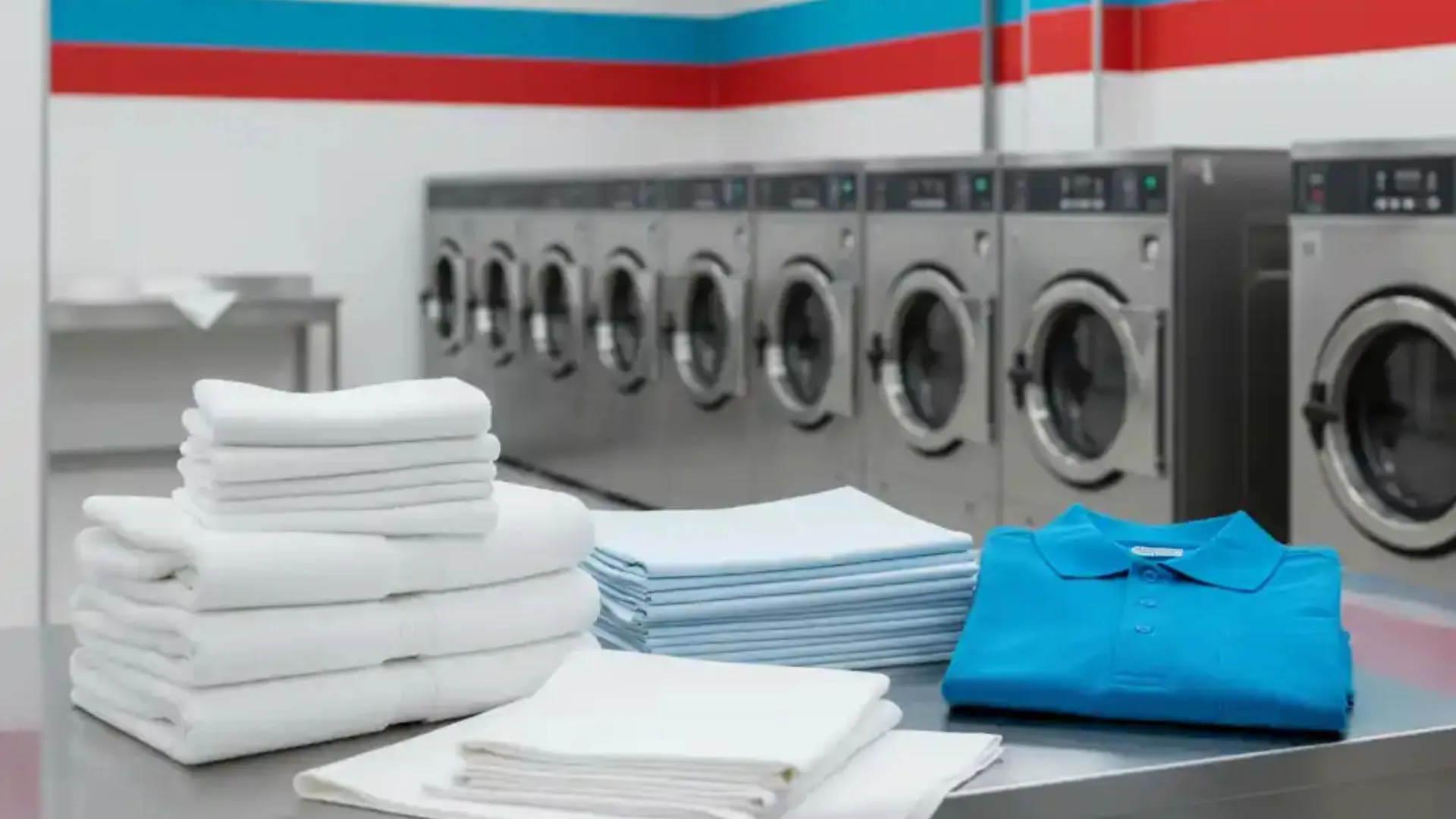
Corporate textile management is regarded as the foundation of operational efficiency and hygiene integrity. Bursa laundry solutions operate with traceable and standardized processes designed for the intense cycles of the hotel, healthcare, manufacturing, and service sectors. Throughout the collection–washing–drying–ironing–packaging line, automation, quality control, and reporting steps directly affect brand reputation, guest experience, and maintenance costs. Within the Bursa laundry ecosystem, digital planning, RFID/QR tracking, chemical dosage management, water/energy recovery, and logistics coordination operate in harmony. Such a structure consistently delivers results across categories like bed sheets, towels, bathrobes, tablecloths, uniforms, and medical textiles. For corporate managers, this approach represents both operational calmness and sustainable quality.
Professional Cleaning Solutions with Bursa Laundry Services
The Bursa laundry infrastructure consists of processes designed to extend the lifecycle of corporate textiles and ensure consistent hygiene standards. Each textile class follows specific washing recipes supported by sensor-based control of heat–time–mechanical interaction and chemical balancing. Thus, laundry Bursa lines maintain result consistency between pieces, even during peak periods. For hotels, processing bed linens and bathrobes separately; for restaurants, tablecloths and napkins; and for healthcare institutions, sheets and surgical gowns under distinct parameters is critical for color stability, fabric softness, and hygiene validation. In Bursa laundry facilities, each batch is assigned a barcode/RFID work order, scanned at every entry–exit point, and verified at the quality station.
Thanks to optimized delivery/pick-up routes, the production schedule and logistics plan progress in sync. This discipline reduces delay risk and enables transparent data flow across the warehouse–laundry–facility triangle. Common peak hours in hospitality and sudden demands in healthcare are managed through this planning capability. Smart dosing systems in Bursa laundry lines adjust chemical use according to fabric type, soil level, and water hardness. This method prevents unnecessary rewashing in industrial washing Bursa operations, ensuring savings in energy, water, and detergent consumption.
The core of the service range covers hotels, spas, restaurants, hospitals, and production facilities. In accommodation, items like duvet covers–pillowcases–flat sheets–fitted sheets; in spas, peshtemals–towels–bathrobes; in restaurants, tablecloths–runners–napkins; and in healthcare, sheets–patient gowns–pillowcases are separated by category within Bursa laundry workflows. Quality control is conducted after washing–rinsing–spinning–drying–ironing through visual and physical testing. Tear strength, shrinkage rate, and color deviation are recorded. This transparency simplifies corporate procurement and internal audits.
One of the most important indicators of guest satisfaction in the hotel segment is the softness of bed linens and absorbency of towels. In Bursa laundry formulations, mechanical stress, temperature curve, and humidity curve are optimized according to fabric type. This approach also minimizes creasing in the ironing–folding stage. Maintenance and repair strategies are applied to ensure operational continuity, reducing breakdown rates and sudden capacity losses. Under sustainability goals, water recovery lines and heat recovery systems are implemented, enhancing the environmental performance of Bursa laundry operations.
When sectoral expertise, delivery SLAs, and reporting depth converge, measurable value is created for managers. Especially in mixed processes where Bursa dry cleaning and wet systems are jointly managed, part separation, stain mapping, and pre-treatment protocols determine success. Corporate clients demand traceable records, batch reports, and monthly quality summaries from their providers. Bursa laundry companies stand out by meeting these needs through digital dashboards and integrations.
A note for hotel managers: During periods of increased guest volume, the ability to activate additional shifts and lines ensures service consistency. Within this framework, Hotel Textile Washing processes are monitored alongside dry cleaning Bursa and wet washing distinctions. On the healthcare side, Hospital Textile Washing procedures operate with high-temperature sterilization and antibacterial rinsing steps. These two domains’ differing hygiene levels are clearly defined within Bursa laundry formulations.
Corporate contract models are determined by quantity–category–frequency–SLA matrices. Many businesses ensure price stability and capacity guarantees through monthly/quarterly agreements. Within professional laundry services, the key performance indicators include stain removal rate, whiteness index, fabric integrity, and on-time delivery percentage. Reports provide tangible data for decision-makers. Bursa laundry providers share these metrics via dashboards, fostering a transparent business culture.
Hotel-Specific Laundry Services in Bursa
Guest experience is enhanced through details such as room organization, scent, fabric softness, and visual harmony. The Bursa laundry setup tailored for hotels systematizes these details through a well-designed architecture. Daily/weekly collection schedules organized by hotel size make return times predictable. Shift distribution is structured to facilitate communication between reception, housekeeping, and laundry teams. Each washed item is tracked via RFID tag, passes through wrinkle-reducing ironing parameters, and is folded and packaged to standard. Each delivered box is labeled with category, quantity, date, and batch code.
The trio of duvet cover–sheet–pillowcase requires close monitoring for whiteness index. In Bursa laundry formulas, combinations providing gentle brightness instead of optical whiteners are preferred, preserving fiber structure and soft touch. For towels and bathrobes, absorbency is enhanced through proper control of spinning and drying curves. That instant sense of dryness at a single touch is achieved through these technical adjustments. On the hotel laundry service side, calender/flatwork ironer maintenance directly affects ironing quality. Skipping periodic maintenance can cause in-day capacity loss.
Stain management is a major component in hospitality. Separate pre-treatment protocols are applied for makeup, oil, wine, or coffee stains. Stain codes are logged at acceptance; verification occurs post-process. This reduces unnecessary rewashing in Bursa laundry lines. In hotels with high room turnover, an “express line” is activated to process specific item types at shorter cycles. This flexibility, planned according to guest density, relieves pressure on housekeeping teams.
Corporate managers plan budgets using metrics such as per-piece processing cost, fabric lifespan, and loss rate. Professional laundry service Bursa prices are determined by these metrics. The most effective way to reduce per-piece cost is correct classification, accurate formulation, and minimal reprocessing. Bursa laundry providers offer capacity-scaling plans for seasonal fluctuations and event periods, ensuring uninterrupted service even at demand peaks.
For non-guest-use textiles such as curtains, decorative fabrics, and coverings, Bursa dry cleaning lines are employed. In water-sensitive fabrics, form retention is achieved through solvent and low-temperature combinations. For staff uniforms, dry cleaning Bursa and wet systems are jointly considered, and the route is defined according to stain type. For hotel SPA zones, peshtemal, towel, and bathrobe sets are processed separately to preserve fabric uniformity.
For hotel managers, report visibility is invaluable. Delivery reports include quantity, category, stain resolution, return reasons, and quality notes. Complaint flow links to corrective action while maintaining traceability. This approach ensures brand standards remain consistent across all branches. The order established by a Bursa laundry partnership creates positive guest feedback regarding textile quality. When needed, the capacity benefits of Industrial Washing lines can also be utilized.
Lastly, security and confidentiality: In cases requiring special handling such as guest belongings, separate acceptance–labeling–locked storage protocols are implemented. These actions are documented in alignment with hotel policies within Bursa laundry operations. Thus, risk management progresses proactively and brand reputation is protected. As hotel scale grows, the benefits of this discipline become more evident.
Advantages of Industrial Textile Washing with Bursa Laundry
For industries such as manufacturing, logistics, and food production, textile washing is a key component of hygiene, occupational safety, and corporate appearance. Bursa laundry lines provide high-capacity, low-error workflows compatible with production shift tempos. Uniforms, aprons, work overalls, microfiber cloths, and floor mops are processed with category-based formulas. Pre-treatment algorithms are applied for stains caused by oil, solvent, or dust particles. Thus, stains are removed in a single cycle, reducing reprocessing costs. As chemical dosage is adjusted to fabric durability, part lifespan is preserved.
Temperature, mechanical action, and time form the critical triad for industrial textiles. Sensors in Bursa laundry facilities monitor these parameters throughout the cycle. If deviations occur, the process halts and corrective steps are triggered. Moisture sensors in ironing/drying stations monitor sensitive points, preventing fiber breakage due to over-drying. In textile washing Bursa workflows, preserving the fiber structure of microfiber cloths is vital for cleaning efficiency. Incorrect drying reduces absorbency, a risk minimized by sensor-controlled lines.
For textiles used in food production and service, odor removal, grease dissolution, and hygiene verification are prioritized. Limonene and oxygen-based solutions remove residues without damaging the fabric. For production facilities, part routing and lot tracking simplify the preparation of inspection reports. Bursa laundry operations benefit from this transparency during internal, third-party, and customer audits. The quality plan covers risk analysis, critical control points, and monitoring frequency.
In large-scale distribution networks, logistics coordination is vital. Planning collection points, estimating arrival times, and optimizing vehicle routes directly impact Bursa laundry performance. During peak hours, secondary routes, additional drivers, or night unloading plans are implemented to prevent congestion. Communication within the warehouse–laundry–field triangle runs through a single channel, eliminating data loss. Corporate agreements include written damage–loss–return protocols for fast resolution of exceptions.
On the sustainability side, water recovery, heat exchanger integration, and chemical consumption optimization are the core aspects of Bursa laundry investments. These initiatives not only reduce environmental impact but also alleviate long-term cost pressure. Energy monitoring software immediately reports consumption anomalies. Operations teams act quickly using these insights. The performance of Bursa laundry service providers is evaluated based on on-time delivery, return rate, quality score, and sustainability metrics.
Industrial clients demand uniform standardization for safety and visibility. Consistency in color, size, and accessories strengthens first impressions. Bursa laundry maintains this standard with labeling and packaging systems. Uniforms are categorized by size–employee–department, minimizing mismatches. In high-soil departments, pre-treatment stations are reinforced; heavily soiled items undergo pre-soaking and enzymatic phases before entering the main cycle.
Quality records are maintained regularly to meet legal frameworks and client standards. Temperature curves, chemical dosage logs, sensor calibration reports, and batch inspections are archived. These records are easily shared during audits. Such structuring elevates the laundry company Bursa supplier to a strategic partner level. For corporate procurement teams, this transparency simplifies risk management and accelerates decision-making.
Industrial Textile Washing Companies in Bursa
Bursa industrial textile washing companies extend textile lifespan across sectors by establishing scalable lines suited to varied needs. In manufacturing, logistics, food, tourism, and healthcare, product diversity is high. Therefore, Bursa laundry lines emphasize category-based formulation and routing. Barcode/RFID traceability prevents item mixing and minimizes errors in bulk deliveries. Quality control proceeds through visual inspection, texture testing, shrinkage measurement, and color deviation analysis. Each batch receives a process card noting remaining lifespan, rewash count, and repair needs.
Flexible models such as night shifts or weekend lines adapt to production schedules. This flexibility is balanced with planned maintenance breaks. Preventive maintenance software manages equipment lifespan, intervening before failure when sensor data shows deviations. Thus, capacity continuity is maintained and Bursa laundry lines operate reliably. In professional laundry services, the low defect rate directly influences total cost.
In healthcare and food industries, hygiene validation requires additional control layers. Temperature logs, chemical residue tests, and UV/ATP verification methods are recorded. These records are swiftly presented during inspections. For restaurant chains, whiteness level and stain removal percentage are critical metrics reinforcing brand perception. Bursa laundry facilities employ formulations that provide brightness without reliance on optical whiteners, preserving fabric integrity.
Reporting forms the backbone of corporate communication. Monthly/quarterly report sets include category, quantity, return reason, quality score, and delivery timing. This visibility ensures procurement, operations, and finance teams work from a shared dataset. Companies offering textile washing Bursa services integrate with ERP and inventory systems for automatic data transfer, minimizing human error. The stain coding system becomes a key to continuous improvement: recurring stain types undergo root cause analysis, leading to formula updates.
In logistics, routing, delivery windows, and in-vehicle sorting plans are essential. Category–client–location-based sorting prevents mix-ups. Each box label clearly displays customer name, batch code, category, and quantity. This discipline speeds up counting at delivery points. Bursa laundry providers establish framed agreements with subcontracted lines to handle extraordinary demand surges; quality standards remain intact, and processes proceed under supervision.
On the workforce side, training determines quality. Periodic sessions cover fabric identification, stain profiling, chemical safety, and equipment handling. Occupational safety standards are reinforced through non-slip floors, heat shields, gloves, goggles, and ergonomic workstation layouts. This approach lowers employee turnover and accumulates expertise. Bursa laundry facilities embrace this culture.
Bursa cleaning company, dry cleaning Bursa, laundry company Bursa
Corporate cleaning and laundry operations directly impact guest experience, employee satisfaction, and audit success. For a Bursa cleaning company, the quality of the textile line enhances the perception of on-site service. Across categories such as sheets, towels, bathrobes, tablecloths, napkins, and uniforms, the trio of formulation–traceability–reporting creates the trust corporate structures need. Bursa laundry providers combine wet and dry systems to deliver fabric-friendly solutions. For water-sensitive pieces, dry cleaning Bursa lines focus on maintaining form–color–texture integrity. Uniforms are processed in separate cycles according to usage intensity.
In multi-location organizations, maintaining standardization becomes complex. Therefore, partnering with a laundry company Bursa ensures written processes, defined KPIs, and swift corrective actions when deviations occur. Each delivery report includes item count and quality notes. The return mechanism is transparent. In cases of color deviation, wear, or remaining stains, root cause analysis is performed. If necessary, formulas, machine parameters, or pre-treatment protocols are updated. Continuous improvement gains meaning in this framework.
Sustainability and cost management are addressed together. Water/energy recovery, reduced chemical usage, and lower rewash rates benefit both budgets and the environment. Bursa laundry service providers utilize energy monitoring software and heat recovery systems to create measurable field impact. This allows finance teams to calculate total cost of ownership using concrete data, maintaining a balance between service quality and cost.
In terms of brand integrity, textile standards reinforce visual perception. Whiteness level, tactile feel, and folding order are strong indicators of quality in the customer’s eyes. A Bursa laundry partnership ensures this signal remains consistent across all branches. In multi-location networks, the process minimizing standard deviation risk is strengthened through training, traceability, and reporting. Visible KPIs on management dashboards accelerate decision-making.
On the integration layer, data sharing with ERP, inventory, and procurement software reduces human error. Barcode/RFID-based part–batch–route matching runs automatically. During inspection periods, temperature, chemical, and quality records are swiftly retrieved. This clarity lowers corporate risk perception and adds value in supplier evaluations. The Bursa laundry culture unites quality, speed, traceability, and sustainability metrics within a single framework.
Each of the healthcare, tourism, food, and manufacturing sectors has unique hygiene and aesthetic standards. The Bursa laundry approach reflects these distinctions in process design, offering textile management aligned with institutional goals. Corporate managers maintain budget control through structured contracts based on quantity, category, and frequency matrices. Thus, service quality remains stable and teams operate with operational ease.