


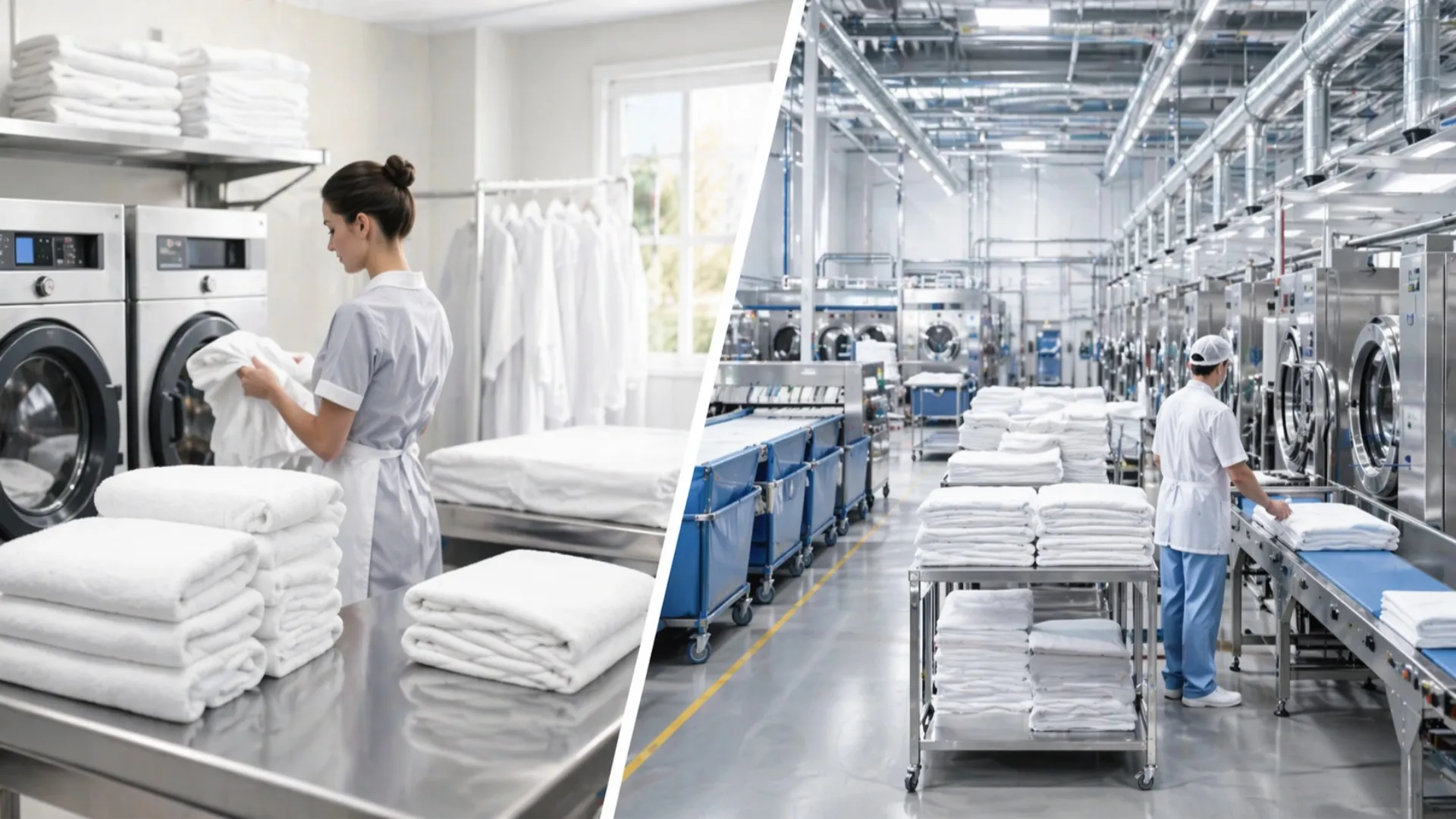
Industrial Laundry Service or In-House Laundry Facility?
Today, textile management has become a critical operation for hotels, hospitals, and corporate businesses in terms of cost, quality, hygiene, and operational continuity. At this point, businesses usually face two main options: building an in-house laundry facility or working with a professional industrial laundry service provider.
At first glance, an in-house laundry system may seem like a more controlled structure. However, when investment cost, staffing requirements, equipment management, maintenance needs, and operational risks are evaluated together, professional industrial laundry service offers a much more practical and efficient solution for most businesses. Serving Bursa and Inegol, Dry Art Laundry aims to provide corporate businesses with a more efficient and sustainable textile management model.
The Difference in Technology and Quality
Industrial laundry facilities operate with high-capacity washing machines, automatic folding systems, flatwork ironers, and advanced process infrastructure. Thanks to this technology, textiles are prepared faster, more consistently, and at a higher quality standard. This creates a major advantage, especially for businesses with high textile volume.
In in-house laundry operations, equipment capacity is usually more limited. A smaller number of machines can reduce processing volume and make it harder to manage peak periods. This may result in longer turnaround times and fluctuations in quality standards. In professional facilities such as Dry Art Laundry, processes can be managed with stronger equipment and more organized operations.
Which Option Is More Advantageous in Terms of Cost?
Building an in-house laundry facility may seem attractive at first. However, this model involves much more than simply purchasing machines. Space allocation, industrial equipment investment, energy use, water consumption, chemical supplies, maintenance costs, and technical service needs all significantly increase the total cost.
In addition, staffing creates another major expense. Operators, ironing staff, folding personnel, and support teams are all needed to keep the internal structure running efficiently. Industrial laundry providers, on the other hand, can often offer the same service at a lower cost thanks to economies of scale. For businesses in Bursa and Inegol, this means access to professional service without the burden of major investment.
Staff Management and Operational Workload
Staff management is one of the biggest challenges for businesses today. In an in-house laundry system, not only equipment but also human resources must be managed. Shift planning, leave schedules, absenteeism, training requirements, and backup staff needs all create an additional burden on the business.
With professional industrial laundry service, all of these processes are handled by the service provider. This allows the business to focus on its core operations while leaving textile management to a specialized structure. As a result, businesses save time and improve operational efficiency.
Operational Continuity and Risk Management
In in-house laundry facilities, a machine failure or staff shortage can disrupt the entire workflow. For hotels, hospitals, and other businesses with high textile usage, such interruptions directly affect service quality. A disruption in textile flow can create serious risks for both customer satisfaction and operational order.
In professional industrial laundry facilities, equipment infrastructure is stronger and workflows are supported with backup systems. This helps ensure continuous operation. Operational continuity is a major advantage, especially for institutions working at high volume. Dry Art Laundry aims to meet this need in Bursa and Inegol with a planned and reliable service approach.
Digital Textile Tracking with RFID
Modern industrial laundry services now offer more than just washing and ironing. With RFID systems, textile products can be counted, tracked, and analyzed digitally throughout their lifecycle.
These systems make it possible to monitor how many times a product has been washed, evaluate its quality condition, and analyze its usable lifespan. This means businesses gain not only laundry service, but also a more controlled and efficient textile management system.
Conclusion
When investment, staffing, maintenance, and operational management are considered together, building an in-house laundry facility is often a costly and difficult model for most businesses. In contrast, professional industrial laundry service offers stronger technology, higher quality standards, lower total cost, and a more sustainable operation.
For hotels, hospitals, and corporate businesses in Bursa and Inegol, Dry Art Laundry can offer a more economical, higher-quality, and more sustainable alternative to building an in-house laundry system. Under today’s conditions, choosing professional laundry service has become a far more efficient and practical decision for many businesses.